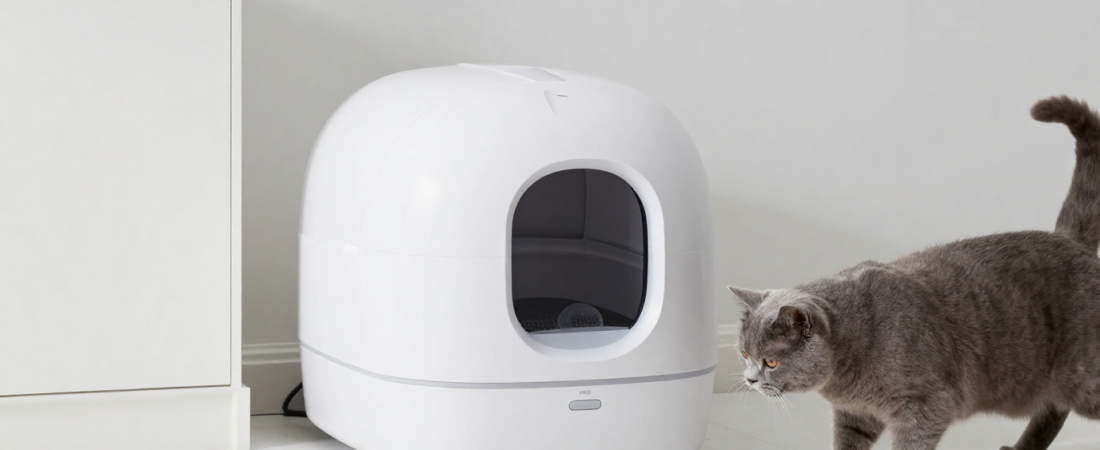
If you have one or more cats, cleaning the litter box is probably the least enjoyable household chore for any owner. Smart automatic litter boxes have been promising to eliminate that task altogether for years, and in 2026, technology has reached a point where that promise is finally a reality for most feline households.
But not all automatic litter boxes are the same. Some simply track waste into a drawer every few hours, while others analyze your cat’s usage patterns, alert you to potential health problems, and clean and deodorize themselves completely autonomously. In this guide, we explain how they work, what to look for before buying, and which are the best models of 2026.
How an automatic litter box works
Automatic litter boxes use sensors to detect when the cat enters and exits. After a programmable waiting period (usually between 3 and 20 minutes after the cat leaves), the cleaning mechanism activates: depending on the model, this may be a rotating rake that pushes the waste into a closed compartment, a rotating platform that separates clumps from the clean litter by gravity, or a dumping system that empties all the litter and returns it filtered.
Connected models also include an app that records each visit to the litter box: time, duration, and, in the most advanced models, the cat’s weight at each visit. This data is invaluable for detecting changes in elimination habits that may indicate urinary tract infections, constipation, or other health conditions.

Real advantages of an automatic sandbox
- It eliminates the need to clean the litter box by hand daily.
- Reduce odors by separating waste immediately after each use.
- Monitor the frequency and duration of visits to the litter box, a key health indicator.
- Ideal for homes with multiple cats: manages the needs of multiple animals without intervention.
- It reduces human contact with waste, improving home hygiene.
The best automatic sandboxes of 2026
Litter-Robot 4 — The absolute benchmark
The Litter-Robot 4 is the best-known and highest-rated automatic litter box on the market. Its rotating globe mechanism separates clumps from clean litter using gravity and deposits them into a closed lower drawer that only needs emptying every 1-2 weeks, depending on the number of cats. The app records each visit, the cat’s weight, and alerts you if it detects abnormal usage patterns. It works with standard clumping litter and can accommodate cats up to 11 kg. The main drawback is the price: €600-€650. But anyone who owns one wouldn’t go back to a manual litter box.
PetSafe ScoopFree Ultra Smart — The most practical alternative
The ScoopFree uses disposable glass litter trays that are sealed and changed every 20-30 days. You don’t need to touch the litter or waste at any time. The app displays usage statistics and health alerts. It’s smaller and quieter than the Litter-Robot. Price: €180-€220 plus the cost of the disposable trays (around €20 per month).
PETKIT Purobot Ultra — The most advanced technological option
The PETKIT Purobot Ultra, unveiled at CES 2026, is the most technologically advanced litter box on the market. It features an internal surveillance camera, a weight sensor that records health data, a negative ion deodorization system, an automatic litter dispenser, and complete app control. The ecosystem integrates seamlessly with other PETKIT devices. Price: €450-€500.
Catlink Scooper Pro X — The best value for money
For those who want a functional automatic litter box for under €200, the Catlink Scooper Pro X offers automatic cleaning, an app with basic statistics, an enclosed design that reduces odors, and capacity for homes with up to two cats. Price: €150-180.
How to adapt it for your cat
The biggest challenge with automatic litter boxes isn’t the technology itself, but convincing your cat to use it. Some cats adopt the new litter box in minutes; others take weeks or simply reject it. The key is a gradual transition.
Place the automatic litter box next to the traditional litter box for at least two weeks. Don’t remove the traditional litter box until you see that your cat is using the automatic one normally. Some cats need the automatic litter box turned off for the first few days to get used to the mechanism before they use it with them inside.
Is the investment worthwhile?
For households with one or two cats and owners who spend many hours away from home, the answer is clearly yes. The improved hygiene, the elimination of daily cleaning, and the health monitoring provided by connected models more than justify the price, especially considering that early detection of a urinary tract infection or kidney problem can save hundreds of euros in veterinary treatments.
Conclusion
The smart automatic litter box is one of the most impactful gadgets in a cat owner’s daily life. The Litter-Robot 4 remains the benchmark if budget isn’t an issue. For those seeking a balance between price and performance, the Catlink Scooper Pro X or the PetSafe ScoopFree are solid options. And for the tech-savvy, the PETKIT Purobot Ultra represents the state of the art in 2026.
Frequently asked questions
Does it work with any type of sand?
Most automatic litter boxes require clumping litter to function properly. Silica litter works with specific models like the ScoopFree. Wood, pellet, or biodegradable litter is generally not compatible with rake or rotating globe mechanisms.
Are they safe for puppies or small cats?
Most carriers have minimum weight sensors that prevent the mechanism from activating if the animal is inside. Even so, for kittens under 6 months old or cats weighing less than 2 kg, check the manufacturer’s specifications before purchasing.
What happens if the power goes out?
Most models remain inactive but in a safe resting position. Some have a backup battery. The sandbox can be used manually during a power outage.
How much noise do they make?
Noise levels vary by model. The Litter-Robot 4 is relatively quiet (around 45 dB during the cycle). The loudest noise typically occurs during the cleaning cycle, which lasts between 2 and 4 minutes.
Posts relacionados
Smart lighting and pets: how the connected home improves animal welfare

June 8 , 2026
When we think about smart home technology for pets, the first things that come to mind are automatic feeders, cameras,…
Read moreHow to make your home smart: a step-by-step guide to getting started from scratch
May 26 , 2026
Just ten years ago, talking about a smart home conjured up images of futuristic mansions or science fiction movies. Today,…
Read more