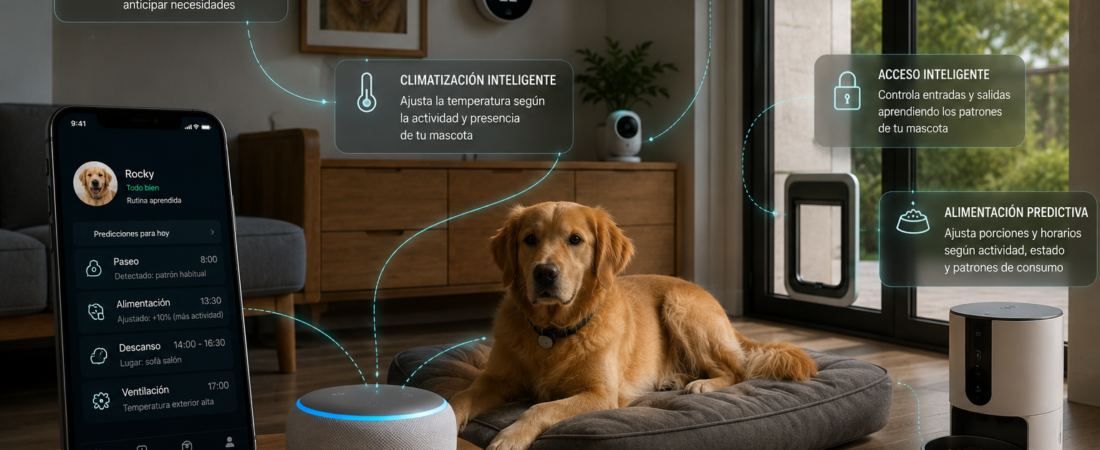
Self-learning assistants: how predictive AI is taking home automation beyond manual programming to create homes that adapt to each pet’s routines.
Programming a smart home has always required some effort. Defining schedules, creating routines, setting conditions… The promise of home automation has always been to free you from repetitive tasks, but the irony is that to achieve this, you have to invest time configuring those automations. Predictive AI is radically changing that equation.
A home with predictive AI doesn’t need you to explain your routines. It learns them on its own, observing behavioral patterns over days and weeks, and infers what you need before you’ve even articulated it. Applied to homes with pets, the result is an environment that adapts to the animal’s lifestyle automatically, without human intervention, and with a precision that no manual programming could match.
Learning routines: from manual programming to observed behavior
The difference between a conventional thermostat and one with predictive AI is revealing. The conventional one executes what you program it to do: it raises the temperature at 7:00, lowers it at 9:00, and raises it again at 18:00. If one day the owner stays home or the dog is left alone for longer than usual, the thermostat doesn’t know.
A thermostat with predictive AI, like the Google Nest Thermostat, learns your home’s actual patterns in just a few days: what time the family leaves, when they return, when the dog is home alone, and how long it takes for the house to reach a comfortable temperature. With this information, it doesn’t just run predefined routines; it anticipates needs and adjusts the system before the situation requires it. If it detects that you usually return home earlier on Fridays, it proactively adjusts the heating.
For homes with pets, this has concrete implications: the temperature never drops below a safe level when the animal is alone, the system learns that the dog needs more ventilation after its most active playtime, and the climate control adapts to the seasons without the need for manual reprogramming.
Computer vision: the home that sees and learns
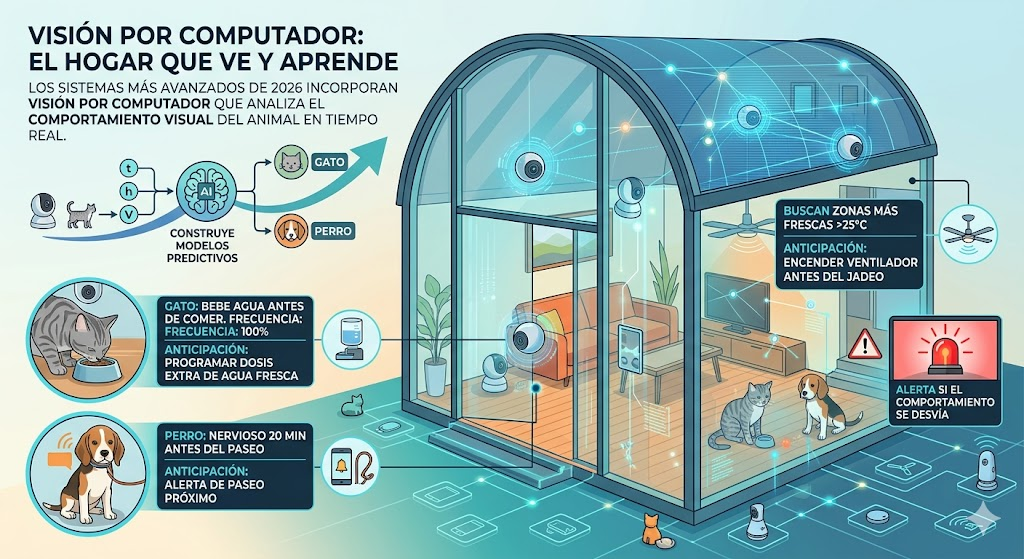
Predictive AI doesn’t just learn from numerical data like temperatures or electricity consumption. The most advanced systems of 2026 incorporate computer vision that analyzes the animal’s visual behavior in real time and builds predictive models based on what it observes.
A camera with AI trained to recognize pet behavior can learn that your cat always drinks water before eating, that your dog gets restless about twenty minutes before its usual walk time, or that the animal tends to seek out the coolest areas of the house when the temperature exceeds 25 degrees Celsius. With this knowledge, the system can anticipate actions: turn on the fan before the animal starts panting, schedule an extra dose of fresh water before its usual visit to the water bowl, or send an alert if the behavior deviates significantly from the established pattern.
Predictive feeding: beyond the programmed feeder
The new generation of automatic feeders integrates learning modules that go far beyond simple time programming. Platforms like those from PETKIT analyze the animal’s daily consumption history and detect patterns: days when it eats more (usually after increased physical activity), days when it eats less (a possible sign of stress or discomfort), and variations depending on the season or time of day.
With this information, the system can automatically adjust portions and feeding times dynamically, not statically. If the GPS collar detects that the dog has run more than usual this morning, the feeder can adjust the afternoon portion to compensate for the increased energy expenditure. If the animal has been eating only half its usual portion for two days, the system flags it as an anomaly that requires attention.
Predictive security: anticipating before reacting
Home security also benefits from predictive AI when pets are present. The most advanced smart alarm systems of 2026 learn the difference between a cat’s usual nighttime movements and an unusual movement pattern that could indicate a problem. If the animal normally sleeps in the bedroom and the sensor detects continuous activity in the kitchen at 4 a.m., it can send a differentiated alert.
Similarly, access control systems learn the usage patterns of pet doors and can detect anomalies: if the cat flap has been inactive for hours when the dog normally goes in and out several times, something may have changed in its routine.
Why it matters
Predictive AI in homes with pets represents a shift from home automation that simplifies tasks to one that anticipates needs. For owners already using smart devices, it’s the natural evolution that eliminates the system’s main source of friction: the need to program everything manually. For those who haven’t yet made the switch, it’s the definitive selling point: a home that learns on its own and adapts to your life and your pet’s without you having to spend hours configuring it.
A home that cares for your pet when you can’t is no longer science fiction. It’s technology available today, affordable, and constantly improving.
Posts relacionados
Smart lighting and pets: how the connected home improves animal welfare

June 8 , 2026
When we think about smart home technology for pets, the first things that come to mind are automatic feeders, cameras,…
Read moreThe pet-friendly home of the future: smart doors, sensors, and spaces designed for pets.
May 26 , 2026
Connected homes no longer ignore pets: doors that recognize the microchip, sensors that distinguish people from animals, and routines that…
Read more