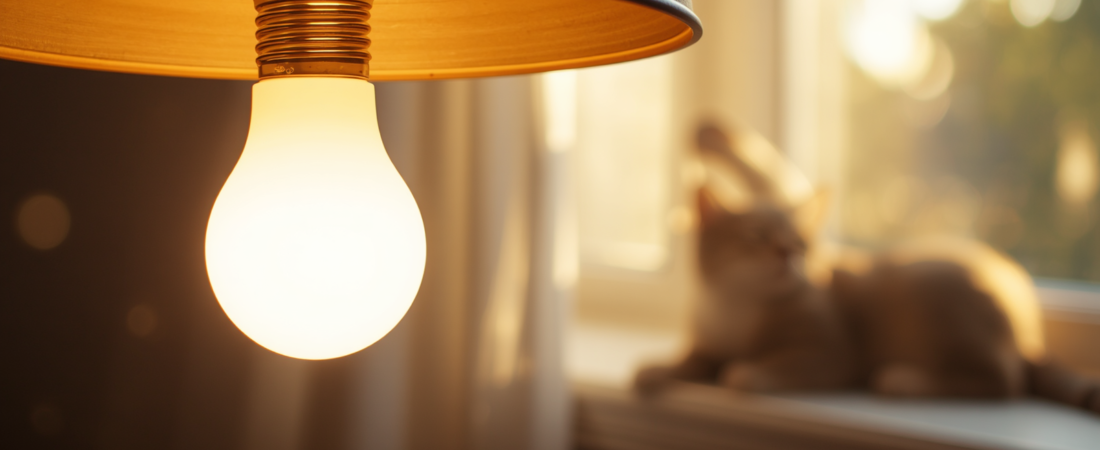
When we think about smart home technology for pets, the first things that come to mind are automatic feeders, cameras, or GPS. We rarely think about lighting. However, the light your pet receives during the day has a direct and documented impact on their circadian rhythm, stress levels, sleep quality, and even their immune system.
Smart lighting in homes with pets isn’t just a convenience. It’s an animal welfare tool that very few owners are taking advantage of yet.
Why light matters for your pet
Circadian rhythm in dogs and cats
Dogs and cats have circadian rhythms regulated by light, just like humans. Exposure to natural light during the day and darkness at night regulates the production of melatonin, the sleep hormone, and synchronizes all bodily systems. A pet that spends the day in a dark apartment without natural light can develop sleep disturbances, lethargy, behavioral changes, and even depression.
Dogs are diurnal animals that are naturally more active during the day. Cats are crepuscular, with peak activity at dawn and dusk. Respecting these rhythms with home lighting significantly improves their well-being.
Color temperature matters
Blue light with a high color temperature (6000-6500K) has an activating effect on the nervous system, similar to direct sunlight. Warm light with a low color temperature (2700-3000K) has a relaxing effect. Smart bulbs like Philips Hue or LIFX allow you to program the color temperature automatically throughout the day, simulating the progression of natural sunlight.
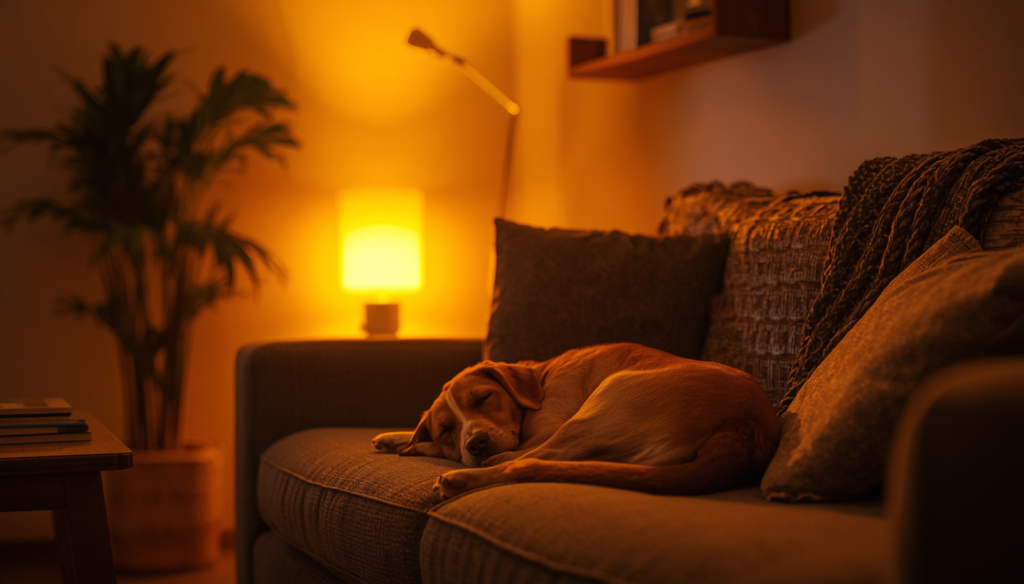
Lighting automation that’s beneficial for pets
Sunrise and sunset simulation
One of the simplest and most effective automations: program the living room lights to gradually brighten from 7:00 AM until they reach maximum brightness at 9:00 AM, simulating sunrise. In the evening, gradually reduce the intensity and color temperature from 6:00 PM until they turn off completely at 10:00 PM. Your pet will experience natural light cycles even while spending the day indoors.
Simulated presence for pets alone
If your pet spends many hours alone, the complete absence of light stimulation can increase anxiety. Establish lighting routines that simulate human presence: intermittent on/off cycles in different rooms, and variations in intensity throughout the day. This not only benefits your pet emotionally but also acts as a deterrent against potential theft.
Emergency night lighting
Cats have superior night vision to humans, but they can’t see in total darkness. Dogs, especially older ones, can become disoriented in complete darkness. A low-intensity LED strip in the hallway or near the litter box, programmed to remain on at a very low power level throughout the night, improves orientation and reduces accidents.
Motion sensors and adaptive lighting
Motion sensors combined with smart lighting allow you to create environments that automatically respond to your pet’s presence. For example, the hallway light might turn on when your cat passes by at night, the feeder light might activate when your dog approaches to eat, or the garden lights might illuminate when your pet goes outside.
For homes with cats especially, motion sensors require calibration to ignore the animal’s movement and prevent lights from turning on unnecessarily at night. Next-generation sensors like the Aqara FP2 allow you to define detection zones and sensitivity thresholds that distinguish between the movement of people and that of small animals.
The importance of natural light
No amount of artificial lighting, however advanced, can completely replace the benefits of direct sunlight. Make sure your pet has access to areas with natural light for at least a few hours each day. If you live in an apartment with limited natural light, consider adding a full-spectrum light therapy lamp to your pet’s usual resting areas, especially during the winter months.
Colors that affect dogs and cats
Dogs have dichromatic vision: they see blue and yellow clearly, but red and green appear as shades of yellow or brown to them. Cats have a similar color perception. This has practical implications: toys or resting areas in blue or yellow are more visually stimulating for them than red or green ones.
Conclusion
Smart lighting is one of the most underutilized pet welfare tools. With bulbs like Philips Hue, LIFX, or Govee and a couple of well-configured automations, you can create a lighting environment that respects your pet’s natural rhythms, reduces stress, and improves sleep quality—all completely automatically and at no significant additional cost beyond the initial installation.
Frequently asked questions
Are LED lights safe for pets?
Yes. Certified quality LED lights are completely safe for dogs and cats. Always choose CE-certified bulbs and avoid very low-cost ones without guarantees, as they can flicker at frequencies that animals can perceive even if humans cannot.
Can cats see the colored lights of LED strips?
Yes, but differently than humans. Blues and greens are more visible to them than reds. Many cats are fascinated by moving LED strips, which can be stimulating or stressful depending on the animal.
Should I turn off all the lights when I leave home?
Not necessarily. Leaving a dim light on during the day in the room where your pet spends most of its time can reduce separation anxiety. Avoid leaving it completely dark for extended periods.
Do flashing lights stress pets?
Yes. Low-quality bulbs that flicker at 50-60 Hz can be perfectly visible to dogs and cats, which have a higher flicker fusion rate than humans. This can cause stress and irritability. Always use quality bulbs with a stable LED driver.
Posts relacionados
Homes with predictive AI for pets: when the house learns before you do
May 26 , 2026
Self-learning assistants: how predictive AI is taking home automation beyond manual programming to create homes that adapt to each pet's…
Read moreThe pet-friendly home of the future: smart doors, sensors, and spaces designed for pets.
May 26 , 2026
Connected homes no longer ignore pets: doors that recognize the microchip, sensors that distinguish people from animals, and routines that…
Read more