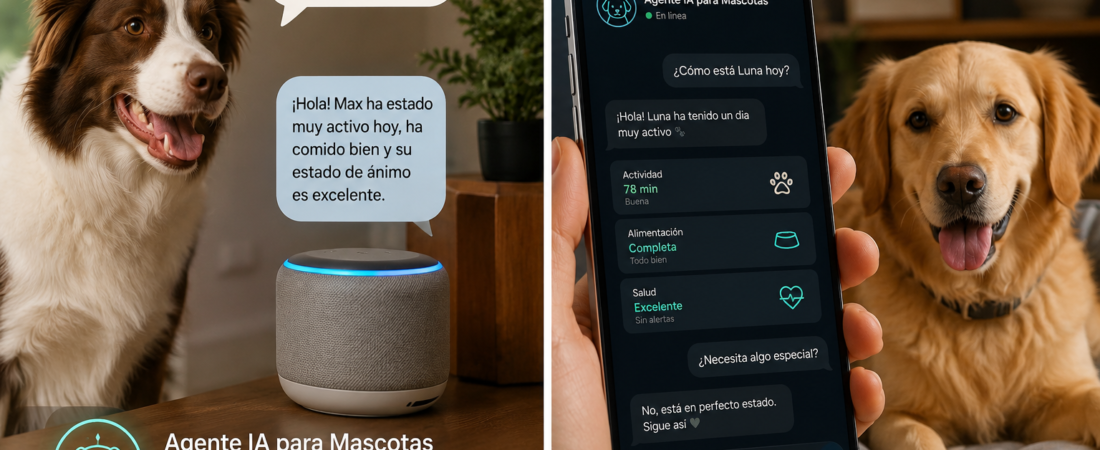
Beyond voice assistants: how autonomous AI agents are redefining what it means to care for a pet in the digital age.
Asking Alexa when your dog last ate is one thing. Having a system that analyzes that data along with sleep patterns, activity levels, and veterinary history, and then autonomously adapts the animal’s routines, is something else entirely. That’s what artificial intelligence agents applied to pet care promise—one of the most disruptive trends in the pet tech sector in 2026.
While chatbots answered questions and assistants executed commands, AI agents reason, plan, and act independently, continuously learning from the data they receive. Applied to homes with pets, the potential is enormous: systems that detect abnormal behavior patterns, automatically adjust feeding, coordinate veterinary appointments, and maintain an up-to-date health record without the owner having to do anything.
AgenticPet.ai: the first ecosystem of autonomous agents for pets
In May 2025, Digital Landia, in collaboration with PetVivo Holdings, launched AgenticPet.ai, presented as the first multi-agent pet care platform. The proposition is ambitious: instead of a single AI model responding to queries, the platform deploys a network of specialized agents that coordinate with each other as a team.
There’s one agent dedicated to nutritional monitoring, another to behavioral monitoring, another to preventative health, and another to coordinating with veterinary professionals. They all share information in real time and collaborate to generate recommendations that none could produce in isolation. The system learns continuously: the more data it receives about a specific animal, the more precise and personalized its suggestions become.
From simple automation to contextual decision making
The difference between an automatic feeder and an AI agent is the same as that between a timer and a family doctor. The former executes instructions. The latter interprets context, asks questions, and adapts its response to the patient’s specific situation.
An AI-powered pet agent can detect that a dog has been eating less than usual for three days, cross-reference that data with the home’s temperature history (obtained from the smart thermostat), the reduced activity recorded by the GPS collar, and a similar pattern that occurred six months prior, just before an episode of gastritis. With this information, it can suggest to the owner that they take the animal to the veterinarian with a concrete hypothesis, not just a vague feeling that something is wrong.
Smart home integration: the next natural step
AI-powered pet agents don’t operate in a vacuum. Their value multiplies when integrated with the smart home ecosystem: thermostats, cameras, lighting systems, robot vacuums, and feeding devices. An agent platform connected to all these sensors provides a much more comprehensive view of the animal’s daily life than any isolated device.
Imagine a specific scenario: the security camera detects that the cat hasn’t moved from a corner for hours. It cross-references this with the lack of activity at the food and water bowls, and with an unusually high indoor temperature registered by the thermostat. The result is an alert to the owner with all the relevant information and a suggestion to lower the temperature or take the cat to the vet. All without human intervention, without manually checking each device.
Privacy and trust: the unfinished debate
The development of autonomous AI agents in the home raises legitimate questions about privacy and control. These systems require continuous access to highly sensitive data: images of the home interior, behavioral patterns, schedules, and family routines. Responsible management of this data is essential for the technology to gain the trust of pet owners.
The most reputable platforms in the sector are focusing on local processing of sensitive data, minimizing the information sent to external servers, and implementing transparency policies that clearly explain what data is collected and for what purpose. European regulations on privacy and the use of AI will also play a significant role in how this sector develops in the coming years.
Why it matters
AI-powered pet care agents represent a profound shift in mindset: from technology that simplifies tasks to technology that takes on responsibilities. For the time-poor owner, this can mean the difference between a well-cared-for pet and one that accumulates minor health issues that go undetected. For the dedicated owner, it’s a support tool that exponentially expands their capacity for observation and care.
Autonomous pet care isn’t in the distant future. It’s happening now, and pet-owning households that adopt these technologies in the next two to three years will have a real advantage in their animals’ health and well-being.
Posts relacionados
GPS for dogs: a complete guide
May 26 , 2026
Losing a dog is one of the most distressing experiences a pet owner can go through. A moment of inattention,…
Read moreWearable devices for pets: the best collars and smart health devices in 2026
June 8 , 2026
The wearables revolution, those devices we wear on our wrists to measure steps, heart rate and sleep quality, has arrived…
Read more